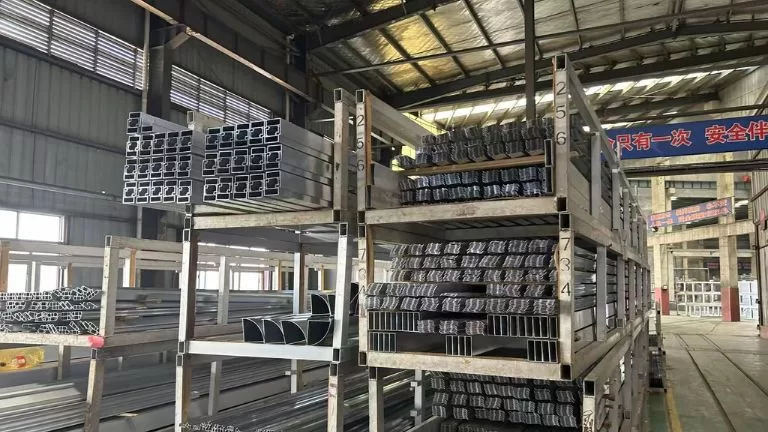
Understanding Extruded Aluminum Heat Treatment
Heat treatment is a critical process for enhancing the mechanical properties of aluminum extrusions. By precisely controlling heating and cooling cycles, we can modify the material’s microstructure—specifically the size, distribution, and stability of precipitates—to achieve desired levels of strength, toughness, corrosion resistance, and dimensional stability.
The heat treatment of aluminum profiles primarily involves two key stages: Solution Heat Treatment (Quenching) and Artificial Aging.
Solution Heat Treatment (Quenching)
Solution heat treatment, often simply called “quenching,” is performed in-line with the extrusion process. As the profile exits the extrusion die at a high temperature, it is rapidly cooled by passing through a water bath located immediately after the die. This quenching process “freezes” the alloying elements in a supersaturated solid solution, which is a necessary prerequisite for subsequent age hardening.

Artificial Aging
Artificial aging involves placing the extruded profiles into an aging oven, where they are held at a controlled temperature for several hours. This process encourages the formation of fine, uniformly distributed precipitates that impede dislocation movement, thereby increasing the material’s strength and hardness. The aging parameters, such as temperature and time, determine the size and density of these precipitates, allowing for a tailored balance between strength, ductility, and toughness.
T5 Heat Treatment (Air Quench, then Artificial Aging)
The T5 temper process begins by cooling the hot aluminum profiles with air (or a forced-air system) immediately after extrusion, which is followed by an artificial aging process. This gentler cooling method results in moderate strength but offers excellent dimensional control.
Because the air quench minimizes the risk of warping or distortion, the T5 temper is ideal for applications where maintaining tight geometric tolerances is a primary concern. It is often chosen when the specific alloy and profile shape can achieve the required mechanical properties without resorting to more aggressive quenching methods.
T6 Heat Treatment (Water Quench, then Artificial Aging)
The T6 temper begins with an immediate water quench after extrusion, which rapidly cools the profile to lock in a solutionized, supersaturated state. This is followed by a controlled artificial aging process (a bake in a furnace) to develop the alloy’s final properties.
This rapid quench allows for a higher level of supersaturation than the air quench used in the T5 process. As a result, the T6 temper achieves significantly higher strength, making it the preferred method when maximum mechanical performance is the primary goal.
T66 Heat Treatment (Water Quench, Straightening, then Artificial Aging)
The T66 temper is an enhanced version of the T6 process. The fundamental difference is the addition of a mechanical stretching or straightening step after water quenching but before artificial aging.
While the T6 temper focuses primarily on achieving maximum strength, the T66 process adds this straightening step to relieve internal stresses and correct distortion. This results in a profile with strength comparable to T6, but with the significant advantage of improved dimensional accuracy and stability.

T73 Heat Treatment (Dual-Stage Aging for 7xxx Series)
The T73 temper is a specialized process for 7xxx series alloys designed to maximize corrosion resistance. Its defining feature is a dual-stage aging process, where the material is subjected to two different aging temperatures after the initial water quench.
This two-step treatment intentionally “over-ages” the alloy, sacrificing some of the peak strength found in a T6 temper. In return, it achieves a remarkable improvement in resistance to both stress-corrosion cracking (SCC) and exfoliation. T73 is the specified temper when a component’s long-term durability is more critical than its absolute maximum strength.
T4 Heat Treatment (Water Quench, Natural Aging)
The T4 temper creates a temporary, workable state with good formability. It involves a water quench followed by natural aging at room temperature, during which the material develops moderate strength.
This intermediate state is ideal for bending or shaping parts before they are fully hardened. After forming, the part is typically artificially aged to a final T6 temper to achieve its full strength.
Heat Treatment Options for Different Aluminum Extrusion Alloys

Heat Treatment for 6xxx Series Alloys (e.g., 6063, 6061, 6082)
The 6xxx series alloys are hardened by the precipitation of magnesium silicide (Mg₂Si). The most common tempers for these alloys are:
T5 Temper: Known for its high throughput and ability to produce profiles with excellent straightness, making it the ideal choice for architectural applications.
T6/T6511 Temper: Delivers higher and more consistent strength, making it the standard for structural profiles and components.
T66 Temper: An enhanced version of T6 that guarantees even higher strength, specified for demanding structural applications in the automotive and rail industries.
T4/T4511 Temper: Provides superior formability. Profiles in this state are meant to be bent or shaped before undergoing a final artificial aging process to achieve a strength level near that of a T6 temper.
Heat Treatment for 7xxx Series Alloys (e.g., 7003, 7075, 7475)
The 7xxx series are high-strength alloys where the choice of temper involves a critical trade-off between maximum strength and corrosion resistance.
T6 Temper: This temper achieves the maximum possible strength for the alloy. However, it’s important to note that some grades can be more sensitive to stress-corrosion cracking (SCC) in the T6 condition.
T73 / T74 / T76 Tempers: These are “overaged” tempers designed to significantly improve resistance to both stress-corrosion cracking and exfoliation. This enhanced durability is achieved with an intentional 5–15% reduction in strength compared to the T6 temper, making it ideal for applications where long-term performance is critical.
Heat Treatment for 5xxx Series (e.g., 5052, 5083, 5456)
The 5xxx series alloys are not precipitation hardenable and therefore do not use the T5 or T6 aging routes common to other series. Instead, their strength is increased through cold working and stabilization.
H Tempers (e.g., H111, H32, H116): These alloys are supplied in various “H” tempers, which signify that they have been strain-hardened (cold-worked) to achieve their desired strength and mechanical properties.

Heat Treatment for 2xxx series (2024/2014/2017, etc.) Heat Treatment
This series is hardened by the precipitation of copper (and sometimes magnesium) and includes some of the highest-strength aluminum alloys available. Common tempers for 2xxx extrusions are:
T3/T4: These tempers combine a solution heat treatment with natural aging (and often stretching for stress relief), resulting in a high-strength material.
T6/T8: For even greater strength and improved fatigue performance, these tempers add artificial aging to the process. The T8 temper specifically includes controlled cold work after the solution treatment and before aging to achieve the highest strength levels.
Heat Treatment for 1xxx & 3xxx Series (e.g., 1050, 1100, 3003)
These series are considered non-heat-treatable, meaning their strength cannot be significantly increased by precipitation hardening.
O, F, and H Tempers (e.g., H14, H24): These alloys are typically supplied in an annealed state (O), as-fabricated (F), or in a strain-hardened (H) temper. The desired strength is achieved by controlling the amount of cold work performed on the material. They are commonly used for decorative trim, electrical conductors, and thermal management applications.