
Heat Sink Types
Where Does the Heat Come From?
According to the second law of thermodynamics, energy spontaneously moves from states of lower entropy to higher entropy. When we try to reverse this process—restoring a system from a high-entropy to a low-entropy state—some of the energy is inevitably lost as heat. As a result, all electronic and mechanical systems generate heat during operation.
The Importance of Heat Sinks
Unchecked heat buildup can increase the temperature of equipment, which directly affects performance, reliability, and service life. Therefore, effective heat sink design is essential for keeping devices operating within safe temperature limits. Solutions range from active cooling methods, such as forced air and liquid cooling, to passive technologies like fin arrays and heat pipes. The ongoing development of new materials, including graphene and vapor chambers, further enhances thermal management capabilities.

This article will provide a concise overview of the main types of heat sinks and their applications.
Structures Types of Heat Sink
The structure of a heat sink directly affects how well it dissipates heat and how easily it fits into different spaces. It is also closely linked to the chosen manufacturing method.
This type uses a metal base and multiple parallel or radial fins to expand the contact area with air. Increasing the surface area allows more heat to dissipate through natural or forced convection.

Fin-type heat sinks are the most common type, used extensively across industrial equipment, vehicles, and electronic products. They are cost-effective and straightforward to manufacture. By adjusting factors such as fin density and height, their thermal performance can be optimized to suit a wide range of cooling requirements.
Pin-Fin Heat Sink
Pin-fin heat sinks are a variation of the traditional fin-type design. They consist of cylindrical or rectangular pins arranged vertically on a base plate. This structure increases the surface area in contact with air and enables efficient heat dissipation regardless of airflow direction, as convection is enhanced in all orientations. However, pin-fin heat sinks generally have higher manufacturing costs compared to standard finned designs.

They are particularly suitable for compact electronic devices and densely packed chips, providing high cooling performance in limited spaces compared to standard finned designs.
Vapor Chamber Heat Sink
Vapor chamber coolers consist of a flat, sealed vacuum chamber filled with a working fluid and a capillary structure. When heated, the fluid evaporates and quickly distributes heat across the chamber, then condenses and returns to the heat source.

This structure is ideal for smartphones, tablets, and high-power LED lighting, enabling very thin designs and maintaining even temperature distribution under high local heat loads.
Corrugated Fin Heat Sink
These heat sinks use fins arranged in wave-like or serrated shapes, which promote air disturbance and increase the heat transfer coefficient. This structure is optimized for forced-air cooling.

Corrugated fin heat sinks are common in automotive radiators, intercoolers, and HVAC condensers. They provide 20–30% higher efficiency than flat fins and have excellent vibration resistance.
Heat Pipe Cooler
A heat pipe cooler uses a vacuum-sealed copper tube with internal fluid to transfer heat by evaporation and condensation. The fluid circulates without any external pump, enabling fast and effective heat transport over long distances.

This technology is used in laptops, graphics cards, and telecom equipment, featuring strong reliability and energy-free operation, and supporting heat transfer over distances greater than one meter.
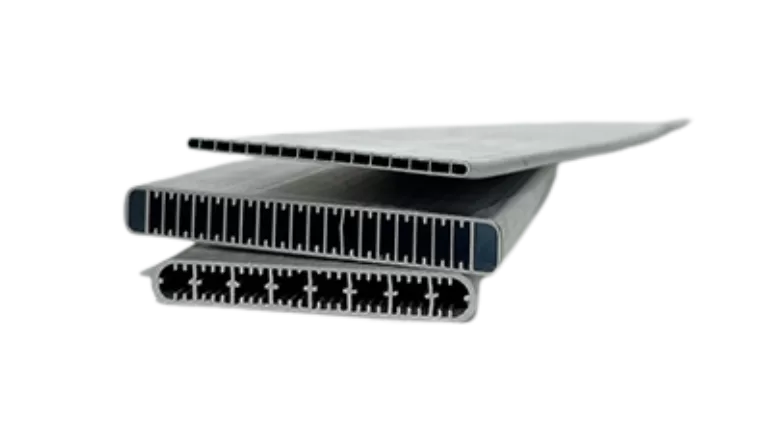
Microchannel Heat Sink
Microchannel heat sinks incorporate tiny channels, often only 0.1–1 mm wide, to allow coolant to flow rapidly through the structure. This results in extremely efficient heat exchange.
Active and Passive Cooling Methods
Cooling systems are divided into passive and active types. Passive cooling uses natural convection or conduction and requires no extra energy, but has limited effectiveness. When this isn’t enough to remove heat, active cooling—such as fans or liquid cooling—is used, which increases cooling efficiency but consumes more energy.
Air-Cooled Heat Sinks (Fan-Based)
These systems employ fans to generate airflow across heat sink fins, rapidly dissipating heat. Widely used in computer CPUs, they often combine copper or aluminum fins with fans, and may include heat pipes in high-performance designs such as those found in modern laptops.

Liquid-Cooled Heat Sinks (Water Cooling)
By circulating water through a closed loop, liquid cooling transfers heat to a radiator where it is released into the air. Automotive radiators are typical examples, constructed with multiple layers of aluminum tubes to maximize thermal transfer.

Oil-Cooled Systems
Similar in principle to water cooling, these use oil as a coolant, making them suitable for high-power industrial equipment or specialized machinery such as transformers and heavy machinery.

Phase-Change Cooling
This advanced method leverages the heat absorption during a medium’s phase transition (e.g., liquid ammonia evaporating). It is typically reserved for extreme cooling scenarios, such as competitive overclocking or experimental laboratories.

Material Types of Heat Sink
Different materials offer distinct thermal conductivity and cost, so composite designs are often used. For example, aluminum is commonly chosen as the base for its easy processing, with other materials such as copper or graphite added as fins or inserts to further improve heat dissipation.
Aluminum is the most common material for heat sinks due to its favorable combination of thermal conductivity (around 205 W/m·K) and low density (approximately 2.7 g/cm³). It offers a balance of efficient heat dissipation, lightweight properties, and affordability. Additionally, aluminum is easy to process by extrusion, casting, or machining, which makes it ideal for large-scale production.

Aluminum heat sinks are widely used in consumer electronics, automotive components, and LED lighting.
Copper Heat Sinks
Copper offers significantly higher thermal conductivity (approximately 398 W/m·K) compared to aluminum, enabling more efficient heat transfer from the heat source. However, copper is heavier, more expensive, and more challenging to machine, which may limit its use in certain applications.

Copper heat sinks are typically used in high-performance applications, such as gaming CPUs, graphics cards, and power electronics.
Graphite Heat Sinks
Graphite heat sinks use synthetic or natural layered graphite materials that offer excellent in-plane thermal conductivity, typically ranging from 300 to 1900 W/m·K. In addition to their extremely lightweight and ultra-thin form factors suitable for space-constrained applications, graphite heat sinks also provide outstanding thermal stability and high fire resistance, with decomposition temperatures reaching up to approximately 3500°C in inert atmospheres.

Ceramic Heat Sinks
Ceramic heat sinks are distinguished by their non-conductive nature, ensuring no electrical conductivity or electromagnetic effects. This property makes them ideal for applications where electrical isolation and immunity to electromagnetic interference are critical, such as in power electronics, high-frequency devices, and sensitive electronic equipment.

The Future of Heat Sink Technology
Heat sinks remain at the core of thermal management systems, with their design and material selection playing a vital role in determining device performance, reliability, and longevity. Advancements in electronics—toward higher power densities and further miniaturization—continue to drive innovation, from classic metal fin structures to cutting-edge microchannels, and from passive cooling methods to active liquid cooling systems.
Efficiency Enhancements: Breakthroughs in phase change cooling, nanomaterials, and biomimetic structures are expected to continuously improve heat dissipation performance.
Intelligent Thermal Management: Developments such as self-adaptive temperature control and AI-optimized flow channel designs will enable dynamic and responsive heat management solutions.
Sustainability: The adoption of recyclable materials and energy-efficient designs aligns with global demands for sustainable and environmentally friendly technologies.
Considerations for Heat Sink Selection
- Thermal Load: Devices with high power density often require liquid cooling or vapor chamber solutions.
- Space Constraints: Compact applications may benefit from heat pipes or graphene-based heat sinks.
- Environmental Conditions: For extreme temperatures, corrosive atmospheres, or vacuum environments, ceramic or specialty alloy heat sinks are preferable.
- Cost Considerations: It is crucial to find a balance between performance and budget, and to avoid over-engineering the solution.