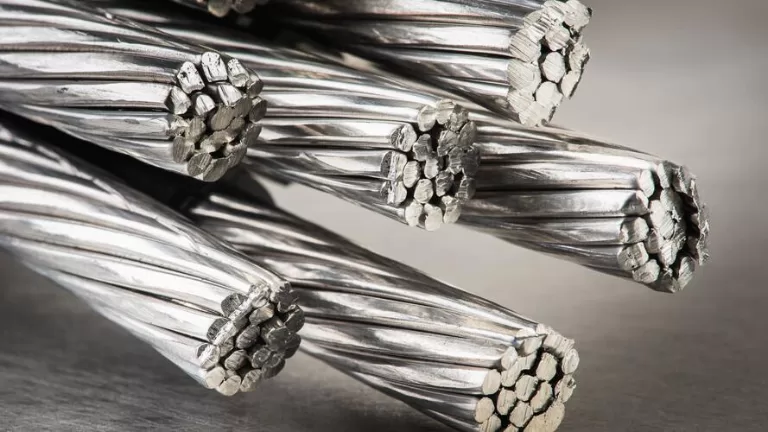
Extruded Aluminum Alloy Hardness
How Hardness Is Expressed for Aluminum Alloys
Aluminum alloy hardness can be expressed using the Rockwell, Webster, Brinell, or Vickers scales.
Vickers (HV): Widely used in production, especially for thin sections. It covers a broad hardness range with a single indenter geometry.
Brinell (HBW): Commonly used for thicker sections and castings.
Rockwell (e.g., HRF/HRB): Less commonly applied to thin extrusions.
Webster (HW): Frequently used in the aluminum industry for rapid, portable checks on extrusions.
How Hardness Is Measured in Production
In production, the Webster hardness tester is often used for quick, on-site measurements of extruded profiles. This handheld device applies a controlled force through an indenter and reads hardness directly on the HW scale, enabling rapid sorting and temper verification with minimal surface preparation.

Primary Factors Affecting Aluminium Alloy Hardness
Alloy composition: Strengthening elements (Cu, Mg, Si, Zn) raise hardness via solid-solution and precipitation. 2xxx/6xxx/7xxx harden mainly by precipitates; 5xxx relies on solid solution and work hardening. Excess impurities (e.g., Fe) can hurt the hardness–ductility balance.
Heat treatment (temper): Solutionising–quenching–aging set precipitate type/size/distribution. Under-aging gives lower hardness with better ductility; peak aging maximises hardness; over-aging coarsens precipitates, lowering hardness but improving stability. Solution temperature/time, quench rate, aging temperature/time, and section thickness control final hardness and uniformity.
Cold work (strain hardening): Rolling, drawing, stretching, and straightening raise dislocation density and hardness in both heat-treatable and non-heat-treatable alloys. Tempers like H12–H18 and T8/T9 reflect intentional cold work. Subsequent recovery/annealing can reduce this hardening, so process sequencing matters.

Aluminum 6061 Hardness
Aluminum 6061, an Al‑Mg‑Si alloy, is commonly checked with the Webster hardness tester on production lines due to its thin‑wall extrusion applications and the need for rapid, non‑destructive verification. Readings depend on temper, profile thickness, quench effectiveness, and aging schedule.
6061‑T5: approximately HW 11–13
Artificially aged after extrusion without full solution heat treatment; moderate hardness with good ductility.
6061‑T6: approximately HW 12–16
Solution heat‑treated, quenched, and artificially aged to near‑peak strength; higher hardness and better load capacity.
Hardness may vary with billet chemistry, section thickness, extrusion speed, quench rate, and the specific aging schedule.
Aluminum 7075 Hardness
7075 is a high‑strength Al‑Zn‑Mg‑Cu alloy. On the Webster scale (HW), it generally reads higher than 6xxx series at comparable gauges due to stronger precipitation hardening. Actual HW values depend on temper, thickness, quench severity, and aging schedule.
7075‑T6 / T651: approximately HW 17–20
- Peak‑strength condition; high hardness from fine η″/η′ (MgZn22) precipitates.
7075‑T73 / T7351: approximately HW 15–18
- Slightly lower hardness due to over‑aging for improved stress‑corrosion resistance and toughness.
7075‑O (annealed): approximately HW 5–8
- Soft condition for formability prior to final heat treatment.
Aluminum 6082 Hardness
Aluminum 6082 is a high‑strength Al‑Mg‑Si alloy similar to 6061 but with higher Mn for grain control. On the Webster scale (HW), its readings depend strongly on temper, section thickness, quench rate, and aging schedule.
6082‑T5: approximately HW 12–14
- Artificially aged after extrusion; moderate hardness with good dimensional stability.
6082‑T6/T651: approximately HW 13–17
- Solution heat‑treated, quenched, and artificially aged to peak or near‑peak strength; T651 includes stress‑relief stretching with similar hardness.

Aluminum 2024 Hardness
Aluminum 2024 is a high‑strength Al‑Cu‑Mg alloy. On the Webster scale (HW), it typically reads higher than common 6xxx alloys in comparable tempers, reflecting its strong precipitation‑hardened matrix. Readings vary with temper, thickness, quench severity, and aging schedule.
2024‑T3/T351: approximately HW 14–17
- Cold‑worked and naturally aged; widely used in aerospace skins and structural components.
2024‑T4: approximately HW 13–16
- Solution heat‑treated and naturally aged; slightly lower HW than T3 due to less strain hardening.
2024‑T6/T651: approximately HW 16–19
- Artificially aged to higher strength; T651 adds stress‑relief stretching with similar hardness.
2024‑O (annealed): approximately HW 6–9
- Soft condition for forming prior to aging.
Aluminum 6063 Hardness
Aluminum 6063 is an Al‑Mg‑Si extrusion alloy optimized for surface finish and intricate profiles. On the Webster scale (HW), it typically reads lower than 6061/6082 at comparable tempers due to its chemistry and strength level. Values vary with temper, wall thickness, quench effectiveness, and aging schedule.
6063‑T5: approximately HW 8–11
- Artificially aged after extrusion; prioritizes formability and anodizing quality.
6063‑T6/T66: approximately HW 10–13
- Solution heat‑treated, quenched, and artificially aged; T66 denotes specially controlled processing achieving higher minimum mechanical properties with similar HW range.

Pure Aluminum Hardness
Commercially pure aluminum (e.g., 1xxx series such as 1050, 1100, 1200) exhibits low hardness due to its nearly pure Al matrix with minimal precipitation strengthening. On the Webster scale, it reads significantly lower than heat‑treatable alloys.
O/H111 (annealed/lightly strain‑hardened): approximately HW 2–5
- Very soft; used where high formability is required.
H12–H14 (quarter/half hard): approximately HW 4–7
- Moderate work hardening from cold reduction; still relatively soft.
H18 (full hard): approximately HW 6–9
- Maximal strain hardening for pure grades; hardness increases, but remains below 5xxx/6xxx levels.
Aluminium Oxide Hardness
The anodic oxide layer on aluminum is primarily amorphous to microcrystalline Al₂O₃·xH₂O with a thin barrier layer and a porous outer layer. Its intrinsic hardness is significantly higher than the aluminum substrate. Reported microhardness for anodic films varies with process type, electrolyte, temperature, and sealing.
Type II (decorative, ~5–25 µm): ≈ 200–350 HV
- Formed in sulfuric acid at moderate temperatures; hardness decreases slightly after hot sealing due to hydration.
Type III (hard anodize, ~25–100 µm): ≈ 350–550 HV
- Produced at low temperature and higher current density; denser microstructure yields higher hardness.
Special electrolytes (oxalic, mixed acids): may reach ≈ 400–600 HV depending on alloy and process control.