
Aluminum Direct Extrusion And Indirect Extrusion
Direct extrusion is currently the main extrusion method, known for its simple equipment and low cost. However, it has certain limitations. Indirect extrusion is often used in areas where direct extrusion is less effective.
Differences in Operation
In direct extrusion, the die is fixed and the aluminium billet is pushed toward the die.
In indirect extrusion, the billet remains stationary while the die is pushed toward the billet.


Limitations of Aluminum Direct Extrusion
Uneven Material Flow
During direct extrusion, the aluminium billet flows unevenly within the container, which results in inconsistencies in grain structure and mechanical properties throughout the extruded product. These issues are particularly significant at the aluminum profile head and tail.
Welding Seams in Hollow Profiles
When producing hollow profiles with direct extrusion, a porthole die is necessary. The aluminium is divided by the die bridges into multiple streams and then recombined in the welding chamber. Slight differences in temperature, flow velocity, and pressure can prevent complete fusion at the weld interface, forming weak seams in the final product.

Increased Friction and Energy Consumption
Friction between the billet and the container during direct extrusion causes a significant amount of mechanical energy to be converted into heat. This results in higher overall energy consumption and elevated temperatures during the extrusion process.
Advantages of Aluminum Indirect Extrusion
Uniform Grain Structure and Mechanical Properties
Indirect extrusion produces a more uniform grain structure and consistent mechanical properties throughout the extruded product. This is because the process avoids friction between the billet and the container, eliminating the uneven flow that can occur in direct extrusion.
High Dimensional Accuracy
Indirect extrusion delivers high dimensional precision. The even flow of aluminium and reduced residual stress contribute to uniform thermal contraction, minimizing distortion and ensuring tight tolerances in the final product. Tolerances as tight as ±0.05 mm can be achieved, meeting demanding specifications for high-precision applications.
Seamless Hollow Profiles
A major advantage of indirect extrusion is the ability to produce hollow aluminium profiles without weld seams. In this process, the aluminium flows evenly from all sides of the die, eliminating the need for a porthole die and thereby avoiding the formation of weld seams, which are common in direct extrusion.
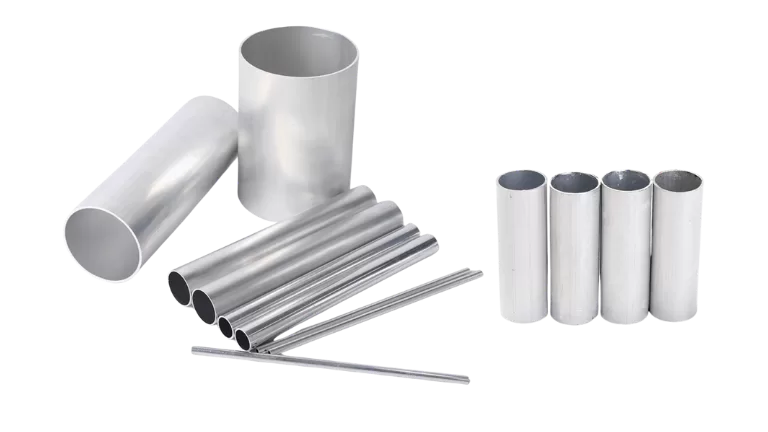
Production of Thinner-Walled Profiles
Indirect extrusion enables the production of thinner-walled aluminium profiles. While the minimum achievable wall thickness in direct extrusion is typically 0.8 mm, indirect extrusion can produce profiles with wall thicknesses as low as 0.5 mm.
Better Suitability for High-Strength Alloys
Indirect extrusion is more suitable for processing high-strength and hard-to-extrude aluminium alloys, such as 7075. The reduced friction in this method lowers the required extrusion force, making it feasible to work with such challenging materials.
Lower Energy Consumption
With significantly less friction between the billet and the container, indirect extrusion is more energy-efficient.
Ability to Manufacture Longer Profiles
Indirect extrusion allows for the production of longer aluminium profiles, as it is not limited by the length of the container.
Conclusion
Direct aluminum extrusion remains the mainstream process, suitable for approximately 80% of standard aluminium profile production due to its versatility and efficiency.
In contrast, indirect extrusion serves as a high-end, “seamless” solution, particularly favored in advanced fields such as military and aerospace applications, where superior material properties and the absence of weld seams are critical requirements.